A conversation about patience, soil, and the beans that became Rais Hamidoux.
When you open a bag of Rais Hamidoux, you smell strength and balance. But behind that cup is not just roasting. It is months of searching, traveling, and meeting farmers who treat coffee as a living craft.
Because Qahwetna means Our Coffee, I have never been interested in volume, only in quality. Choosing coffee for me is like searching for the perfect gift for a friend or family member. It has to carry meaning, not just flavor. That is why I always go the extra mile.
In 2024, I spent several weeks in Vietnam visiting smallholder farms across Dak Lak, Gia Lai, and Lam Dong. My goal was not to buy tons of coffee; I wanted to understand how families grow, harvest, and protect their beans.
That journey ended with one partnership that shaped the future of our strongest coffee: Rais Hamidoux, a 100% Robusta that is powerful, smooth, and naturally sweet. Honestly, it became my proudest find. I had never drunk a 100% Robusta before, and certainly not one that could be enjoyed without sugar. But this one surprised me, it has an immediate Robusta kick that wakes you up and a nutty sweetness that makes every sip satisfying.
1. Meeting the Nguyen Family
On a misty morning near Buon Ma Thuot, I met the Nguyen family. Three generations work on their land, about five hectares surrounded by pepper vines and jackfruit trees. They welcomed me with a small cup of their own roast, dark and earthy.
“Our soil is red like fire,” Mr. Nguyen said, laughing. “If you respect it, it gives you everything.”
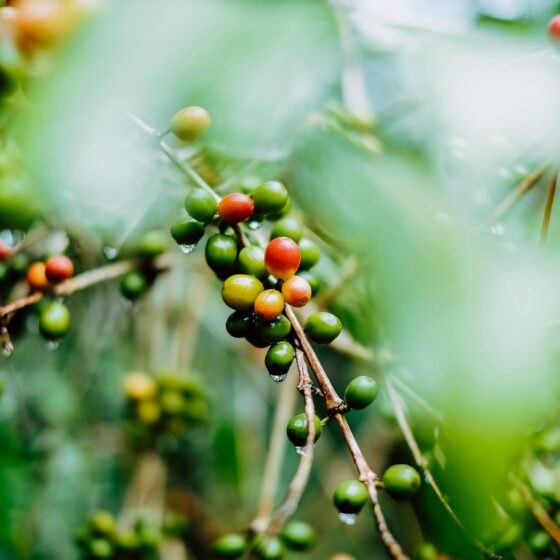
Their Robusta trees are nearly 20 years old. Instead of using heavy fertilizers, they compost the pulp from the coffee cherries and mix it back into the soil. This keeps the flavor rich and clean without the bitterness you find in industrial Robusta.
2. Talking About Quality and Hard Work
The family picks cherries by hand. When I asked why they still do it this way, Mrs. Nguyen smiled:
“Machines are faster, but they cannot see color. We pick only red cherries.”
That single sentence explains why their coffee tastes so different. Every bean is sorted on large bamboo trays before drying under the sun. During my visit, I joined them for a few hours, turning the cherries every half hour to avoid fermentation spots. It was slow work but deeply calming, the kind of rhythm that defines real coffee farming.
3. From Dak Lak to Algeria: The Search for the Right Robusta
Most people think Robusta is harsh, bitter, or cheap. But that is because it is often over-roasted or poorly processed. Good Robusta can be naturally sweet, full of chocolate and spice notes, with a caffeine kick that wakes the mind without burning the tongue.
In Algeria, we have always loved strong coffee. That is why I wanted Rais Hamidoux to represent strength without aggression. The Nguyen family’s beans had exactly that: deep body, soft aftertaste, and natural sweetness.
When roasted carefully in Switzerland for Qahwetna, their Robusta becomes something unique, the perfect base for Rais Hamidoux, named with humor after our history of strength and kindness.
4. The Human Side of Coffee
When I left Dak Lak, Mrs. Nguyen gave me a small bag of dried coffee blossoms and said, “To make tea.”
That gesture reminded me that coffee is first about people. Farmers are not just suppliers; they are artists of soil and patience.
This is what I want Qahwetna to stand for: transparency, fairness, and direct connection between roaster and farmer. Behind every cup, there is a face, a hand, and a story.
5. Why Vietnam Matters for Algeria
Few Algerians realize that much of the Robusta used in Algeria today comes from Vietnam, the world’s largest Robusta producer. The difference is that Qahwetna works directly with small families, not mass exporters.
By choosing our beans personally, we make sure that what arrives in your cup is clean, traceable, and worthy of the name Rais Hamidoux.
Final Thoughts
Rais Hamidoux was born from this journey, from the red soil of Dak Lak to the quiet mornings in Algiers, Oran, or Geneva where Algerians sip their espresso. It is strong, proud, and smooth, just like the people who inspired it.